As a classical Christian community, we believe in the power of truth in education. Teaching your children is more than just math facts and historical dates. When you are educating your kids, you’re preparing them for life outside of your home. That’s why teaching our children to search for truth and learn to discern between truth and lies is so important. The lessons they learn now prepare them for the future. That’s why we advocate for classical education–it teaches students how to think, not what to think.
Mission Statement:
To build a homeschool, Christian community while discipling the next generation to search and stand for truth.
Core Values:
- Biblical truth and worldview
- Core curriculum structure
- Healthy communities
- Academic excellence
- Local governance
- Cultivate classical virtues
What is Classical Education?
Classical education is a time-honored approach that emphasizes the liberal arts, critical thinking, and the pursuit of wisdom, virtue, and truth. It emphasizes reading and discussing significant works of literature and philosophy, fostering cultural literacy, and a deep understanding of the ideas that have shaped Western civilization.
The Difference Between Classical Education and Traditional Education
Classical education differs from traditional education in that it focuses on teaching students how to learn rather than just what to learn. This approach encourages critical thinking, connections across disciplines, and a lifelong passion for learning, rather than rote memorization and standardized testing.
The classical education movement has gained traction in recent decades, with many schools and educational organizations adopting this model. It aims to produce well-rounded individuals who can engage thoughtfully with the world around them, contributing to society as informed citizens and leaders.
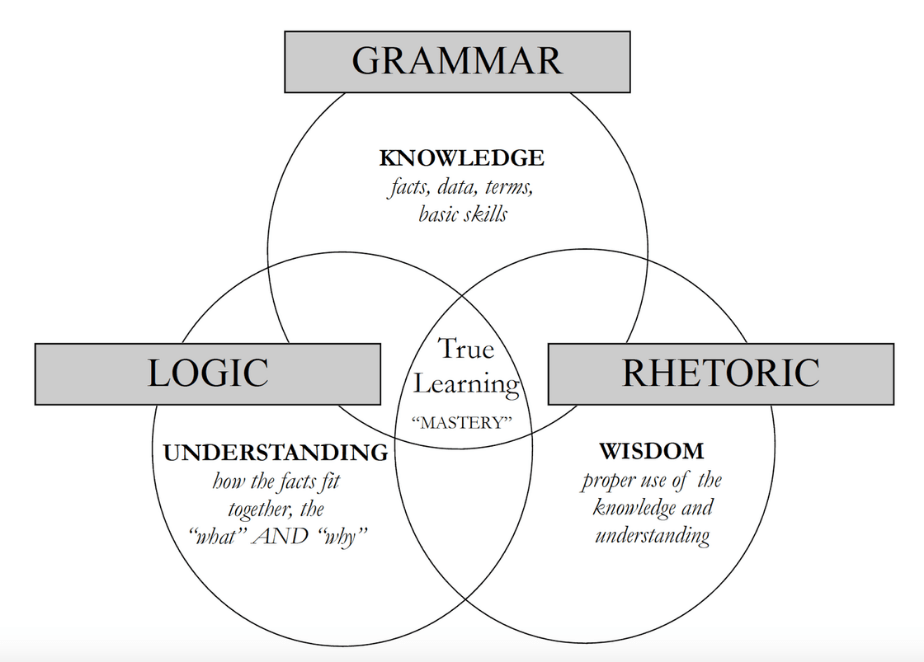
Structure of Classical Education
Classical Education is based on the Trivium. This foundational framework consists of three stages of learning that align with a child’s natural development.
Grammar – PreK-6th
This is the foundational stage where students learn the mechanics of language. It involves understanding the basic vocabulary and structure of various subjects, enabling students to articulate their thoughts clearly. In classical education, this stage emphasizes memorization and recitation, helping students absorb substantial amounts of information.
Logic (Dialectic) – 7th-8th
The second stage focuses on reasoning and critical thinking. Students learn to analyze arguments, identify fallacies, and construct sound reasoning. This stage encourages independent thought and the ability to engage in structured debates, fostering a deeper understanding of the relationships between concepts.
Rhetoric – 9th-12th
The final stage of the trivium teaches students how to effectively communicate their ideas. This includes writing, speaking, and presenting arguments persuasively. Students learn to express their thoughts clearly and confidently, integrating the knowledge gained from the previous stages.